
Veteran Caribbean journalist Julian Rogers condemns referral of CARICOM Secretary-General reappointment to CCJ
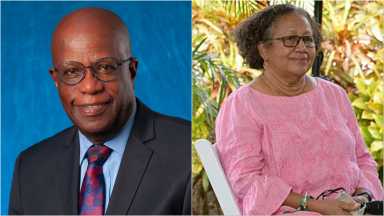
Veteran Caribbean journalist Julian Rogers has condemned the recent decision by Caribbean Community (CARICOM) leaders to refer the reappointment of Secretary-General Dr. Carla Barnett to the Caribbean Court of Justice (CCJ).
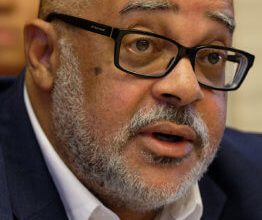
Rogers, a Barbadian-born media consultant based in Belmopan, Belize, told Caribbean Life on Monday, July 13, that Dr. Barnett’s referral is “a maneuver so wrapped in legal irony and political evasion that the giants who labored to establish the court, both living and dead, must be scratching their heads.
“The suggestion, advanced by Trinidad and Tobago, via a meticulous 22-page objection letter and accepted by the broader conference, is to freeze Dr. Barnett in her position until the Court delivers an advisory opinion,” said Rogers, who serves as principal of Caribbean Bridges, a multimedia platform and strategic communications consultancy dedicated to regional integration, governance and geopolitical analysis.
“This effectively bypasses an executive contract framework that requires a minimum of six months’ notice regarding the extension or termination of her tenure,” added Rogers, a broadcaster and media professional with more than 50 years of front-line experience across Barbados, Antigua and Barbuda, St. Kitts and Nevis, Montserrat, Trinidad and Tobago, Jamaica and Belize.
“By using the court down the street to park an uncomfortable political gridlock, Port-of-Spain (the capital of Trinidad) is opening itself up to the biting charge of treating the highest tribunal in the region as the ‘Convenient Court of Justice,'” he continued.
Rogers, a graduate of the pioneering class of the University of the West Indies Mass Media Institute (CARIMAC), who has founded and anchored numerous premier regional news institutions, said that under Article 212 of the Revised Treaty of Chaguaramas (RTC), the CCJ has exclusive jurisdiction to deliver advisory opinions.
“But let us not drown the public in ignorance,” he said. “As is the norm with most international tribunals, an Advisory Opinion is fundamentally non-binding. There is no enforcement authority behind it, unlike a formal, litigious judgment rendered in a legal dispute between member states.
“The CCJ will eventually hand down an opinion that carries strong persuasive authority as the ultimate interpreter of the Treaty,” added the executive director of Caribbean Bridges. “But that opinion will simply be referred right back to the Conference of Heads of Government, the exact same body currently locked in stalemate.”
He said CARICOM heads of government will then have to determine how to incorporate the opinion, if they choose to do so, into CARICOM’s existing governance structures and revert to the treaty’s provisions on how to proceed.
“By running to the Court, the leaders haven’t solved a legal problem; they have merely outsourced a political hot potato to buy time,” Rogers said. “This legal sidestep completely shatters the basic decencies of executive talent management.”
In both the global private sector and reputable multilateral institutions, he said, the requirement for a minimum of six months’ notice regarding the contract of a chief executive officer is an “absolute, non-negotiable guardrail.
“This buffer does not exist merely to accommodate administrative timelines; it is designed to protect the operational continuity of the institution and, crucially, to safeguard the dignity of the office holder,” Rogers said.
He said the appointment or reappointment of a secretary-general is “no trivial procedure,” stating that it entails many months of “rigorous examination of credentials and international vetting.
“By failing to resolve this appointment through established executive channels months ago, and instead choosing to punt it to a judicial body as a stalling mechanism, CARICOM has violated these basic human resource tenets,” he said. “They have chosen to handle a highly sensitive corporate HR (human resources) matter in the unyielding, cold glare of the public theater.
“The severe, unprecedented reputational damage to the incumbent cannot be ignored,” he added. “Dr. Barnett is left sitting in her official residence in Georgetown, Guyana, facing weeks of administrative purgatory under a public cloud of uncertainty. This is nothing short of a public shaming of the region’s top civil servant.
“How can a secretary-general effectively manage relationships with her internal staff, enforce discipline within the Secretariat, or steer the delicate governance structures of CARICOM when her own mandate has been turned into a political football?” Rogers asked. “Her representational functions on the global stage, interfacing with international heads of state, financial institutions and multilateral partners, can in no way be deemed as ‘easy.'”
Rogers said Dr. Barnett’s authority has been “systematically undermined” before the world.
He said the ultimate tragedy of the episode is the message it sends across the region and the wider world.
“Who would ever want to accept a position such as this after this display?” Rogers asked. “What young, brilliant West Indian technocrat, currently excelling in London, New York, or Basseterre, would choose to eschew a lucrative private-sector career to return and labor in the regional vineyard if this is the reward for an impeccable career?”
Rogers noted that Trinidad and Tobago is home to the CCJ’s headquarters and has enacted domestic legislation to give the court international legitimacy by granting privileges, immunities and tax exemptions to its staff and operations in keeping with the Vienna Convention on Diplomatic Relations and domestic law.
Yet, he lamented that Trinidad and Tobago “famously refuses to recognize the CCJ in its appellate jurisdiction, remaining fiercely loyal to the Judicial Committee of the Privy Council in London for its own domestic appeals.”
Rogers recalled that, when asked directly at the conclusion of the recent CARICOM summit in St. Lucia whether Trinidad and Tobago would finally adopt the CCJ as its final appellate court, “seeing that she just successfully steered the entire CARICOM leadership to its doorstep,” Prime Minister Kamla Persad-Bissessar flatly replied, “Not at this time.”
Rogers said the clinical reality is that Port-of-Spain has “engineered a politically convenient paradox.
“When it comes to high-level executive maneuvering, treaty mechanics, and handling an acrimonious stalemate over the secretary-general’s contract, Port-of-Spain views the CCJ as fully competent, authoritative, and a highly useful shield to buy seven weeks of political time,” he said.
“When it comes to the domestic legal rights of its own citizens, ordinary criminal and civil matters, the same government maintains that these West Indian judges aren’t quite ready, leaving final appellate sovereignty anchored to London,” Rogers added. “It is the ultimate ‘have your cake and eat it too’ strategy of regional diplomacy.
“The CCJ is treated as a premium, on-demand arbitration service for prime ministers who want to avoid making a tough call, whilst being denied its full constitutional purpose for the people of Trinidad and Tobago,” he continued.
Rogers said the “entire litigious circus was wholly unnecessary,” stating that the region is “teeming with legal titans of unmatched intellectual rigor.”
He said that if CARICOM heads of government truly required independent, objective clarity on the contract mechanics of the Secretariat, “they did not need to burden the international court.
“They could have easily empaneled an independent board of eminent Caribbean jurists, drawing on brilliant minds like Sir Johnny Cheltenham in Barbados, or the recently retired, peerless former president of the CCJ, Adrian Saunders, and left the CCJ to address the macro-integration issues properly under its competency,” Rogers said. “But a panel of independent jurists would have delivered a swift, definitive answer.
“And a swift answer is exactly what our leaders were trying to avoid,” he added. “Faced with an acrimonious disagreement over executive leadership and a ticking contract window, the head table defaulted to intellectual laziness.”
Instead of acting with executive courage, Rogers said they chose the path of “political convenience, relegating our highest court to a body of convenience and leaving their top civil servant to bear the reputational fallout.
“The summit in Castries (the St. Lucian capital) is over, but our premier regional institutions will be nursing this self-inflicted hangover for a long time to come,” he warned.
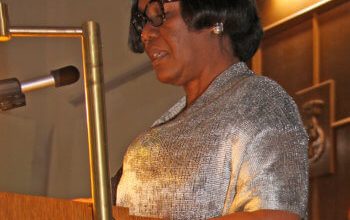
Dr. Barnett, 68, is a Belizean-born economist and politician who has served as CARICOM secretary-general since 2021.
A former deputy speaker of the Belize Senate who also held several ministerial portfolios in the Belize government, Dr. Barnett succeeded Irwin LaRocque, who served as CARICOM secretary-general from 2011 to 2021.
Dr. Barnett, a former economist at the Caribbean Development Bank, holds a Bachelor of Science in economics from the University of the West Indies and a Master of Science in economics from the University of Western Ontario in Canada. In 1990, she received a doctorate in social sciences from the University of the West Indies’ Mona campus in Jamaica.