
Caribbean Diaspora United honors Public Advocate Jumaane Williams, MEC professor Terrence Blackman
The New York-based Caribbean Diaspora United (CDU) on Saturday, July 11, honored New York City Public Advocate Jumaane Williams and Brooklyn’s Medgar Evers College (MEC) professor Terrence Blackman during its 3rd Annual Community Unity Breakfast at Russo’s on the Bay in Howard Beach, Queens.
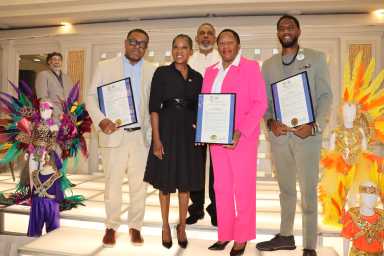
New York State Sen. Siela A. Bynoe — representative for the 6th Senate District in Nassau County, Long Island; a first-generation Caribbean-American who traces her roots to St. Kitts and Nevis and Suriname; chair of the Senate Standing Committee on Libraries; and a member of the Consumer Protection, Education, Environmental Conservation, Investigations and Government Operations, Mental Health, and Transportation Committees — also presented proclamations to Williams and Dr. Blackman.
Trinidad and Tobago Opposition Leader Pennelope A. Beckles-Robinson delivered the keynote address for the second successive year.
Trinidad and Tobago Opposition Leader Pennelope A. Beckles-Robinson, left, poses with Trinidad and Tobago cultural icon Yvette Rennie, president of the Brooklyn-based J’Ouvert City International.Nelson A. KingCBU was founded three years ago by former Grenada Ambassador to the United Nations Eugene Pursoo, who remains its president.
Williams, the son of Grenadian immigrants, considers himself “The People’s Advocate.”
“The mission of Caribbean Diaspora United is a very special one,” Williams said after he was bestowed with the honor. “I see a lot of happenings. They’ve just taken away TPS (Temporary Protected Status for Haitians). We have to do the best we can.
Public Advocate Jumaane Williams gives an acceptance speech.Nelson A. King“This is about white supremacy,” he added. “If we’re not united, it’s a problem. We’re in a situation because of the system we’re in.
“So, we must try to be unified,” continued Williams, urging patrons to repeat “unified.” They obliged.
Dr. Blackman — the Guyanese-born chair of the Department of Mathematics at Medgar Evers College, City University of New York (CUNY), where he will assume the role of interim dean of the School of Science and Allied Health in August 2026 — thanked CBU for the honor.
Miracle Bobb presents award to Dr. Terrence Blackman, left, flanked by CDU President and Founder Eugene Pursoo.Nelson A. KingHe said he was also “proud to share this stage with Public Advocate Jumaane Williams, whose work reminds us that advocacy, done seriously, is a form of love for one’s community.
“The plaque you have given me makes a claim,” Dr. Blackman said. “It says that access and excellence are the same value.
“Unity is not charity extended to the weak,” he added. “Unity, like access, is the condition under which excellence becomes visible.
“When we gather — Guyanese, Grenadian, and Trinidadian, Jamaican and Barbadian, Vincentian and Haitian — we are not diluting our identities. Together, we become evidence ourselves,” Dr. Blackman continued. “So, let me close not with comfort, but with a charge, because gatherings like this one are only as good as what we build after the plates are cleared.
“Access opens the door; excellence walks through it,” he said. “Our job is to make sure neither is ever separated from the other. This morning, you have honored me. Tomorrow, let us honor this plaque by proving it true — in every classroom, every neighborhood, and every child whose future depends on whether we keep the door open. From Georgetown (the Guyanese capital) to Brooklyn: one people, one purpose.”
Dr. Terrence Blackman delivers an acceptance speech.Nelson A. KingBeckles, leader of the People’s National Movement (PNM) in Trinidad and Tobago, told the ceremony that the Caribbean Diaspora doesn’t “celebrate enough” its influences.
“We have to find ways to agree to disagree,” she said. “I want to say to all you have done I personally thank you.
“When I talk of my own vision for Trinidad and Tobago, I talk about the Diaspora,” Beckles added. “My vision is to have a secretariat with a direct link to the prime minister — to build a Diaspora Registry.
“We’ll help [create] a genuine, structured mentorship to engage the Diaspora,” she continued. “Your voice belongs. Unity is not for you to forget where you live now. I’m asking you to unite of yourself.”
Pursoo disclosed that, on Oct. 5, 2027, CDU will launch the Caribbean Hall of Fame with a formal induction gala.
“We want to lift the Caribbean culture and Caribbean people as soon as possible,” he said.
In addition, Pursoo said CDU plans, in the very near future, to publish a quarterly Caribbean journal and establish a “collective” with Caribbean policy makers.
“When these things happen, I want you to be part of this inclusion,” he said.
“There are people of influence,” Pursoo added. “We’re going to bring the policy makers to you.”
More about the honorees
Jumaane Williams
Williams has served as New York City’s Public Advocate since 2019.
Since becoming Public Advocate, the second-highest ranking office in New York City, he has restructured the office to empower staff to prioritize community engagement, outreach, and service.
Williams said he has also passed more legislation in office than all previous Public Advocates combined, including key bills that protect New Yorkers in the workplace and those looking for work, shield struggling homeowners from undue tax burdens, increase public safety, and fight discrimination in the housing systems.
Prior to serving as Public Advocate, Williams represented Brooklyn’s 45th District in the New York City Council from 2009-2019.
Williams, who was diagnosed with Tourette Syndrome and ADHD as a teenager, said he persevered as he came up through the public school system from pre-school to the Master’s level.
After graduating, Williams said he began his career as a community organizer by serving as the assistant director for the Greater Flatbush Beacon School, then later as the executive director of New York State Tenants & Neighbors, where he fought for “truly affordable, income targeted housing across the city and state.”
In 2009, he defeated incumbent Council Member Dr. Kendall Stewart to begin his career as an elected official in the New York City Council.
During his time at City Hall, Williams said he championed landmark legislation to create transformational change.
In his first term on the City Council, Williams said he aimed to end the abuse of the NYPD’s use of stop, question and frisk by sponsoring the Community Safety Act.
He said the legislation was enacted despite a veto from then-Mayor Michael Bloomberg, and “helped put an end to unlawful policing practices typically used in communities of more color, while creating the NYPD’s Office of Inspector General to investigate unlawful or unethical practices within the department.”
As co-chair of the Council’s Task Force to Combat Gun Violence, Williams said he helped launch New York’s Crisis Management System, which funds Cure Violence Groups that work to reduce shootings through a multi-pronged, community-centered approach.
As chairman of the Council’s Housing and Buildings Committee, Williams said he challenged the de Blasio administration’s “inadequate affordable housing plan by advocating for more deeply affordable housing to help prevent communities from being priced out of the five boroughs.”
Dr. Terrence Richard Blackman
He previously served as dean of the School of Science, Health and Technology at Medgar Evers College (2016–2019).
A mathematician and proud alumnus of Queen’s College, Georgetown, Guyana, Dr. Blackman graduated cum laude with honors in mathematics from Brooklyn College, CUNY, and holds M.Phil. and Ph.D. degrees in mathematics from the CUNY Graduate Center.
He has been a member of the School of Mathematics at the Institute for Advanced Study in Princeton, the Dr. Martin Luther King Jr. visiting assistant professor in the Department of Mathematics at the Massachusetts Institute of Technology (MIT), and assistant professor of Mathematics Education in the Morgridge College of Education at the University of Denver.
Dr. Blackman has been honored as a Black History Month Honoree by Mathematically Gifted & Black, and his life and work are documented in The HistoryMakers, the digital repository for the Black experience and the nation’s largest African American video oral history collection, permanently archived at the Library of Congress.
Dr. Blackman said he works in number theory, on the arithmetic and geometry of quaternion algebras, and aspects of the Jacquet–Langlands correspondence within the Langlands Program.
He said his investigations connect to Mark Kac’s famous question: Can one hear the shape of a drum?
Dr. Blackman said his research extends to quantum computation, including work on icosahedral “golden gates” for quantum circuits (with Z. Stier, Quantum Information & Computation, 2023).
Alongside his mathematical research, Dr. Blackman said he is “deeply engaged” with questions of access and excellence in the teaching and learning of mathematics and science, particularly in urban and underrepresented communities.
He said his work examines how to build capacity in the mathematical sciences in ways that affirm and leverage the histories, cultural assets, and resources of minority communities.
With co-author John Belcher of MIT, Dr. Blackman said he has proposed a Cultural Resonance Framework (CRF) for teaching, learning, and knowledge production in mathematics and the sciences (Springer, 2018).
He said his work has been supported by the US Department of Education and the National Science Foundation (NSF).
Dr. Blackman said he served as chair of the Executive Council of the National Alliance for Doctoral Studies in the Mathematical Sciences (the Math Alliance) from 2022 to 2025, during which the Alliance was named a finalist for the Presidential Award for Excellence in Science, Mathematics and Engineering Mentoring (PAESMEM).
He said he led the Alliance’s 2025 transition to the American Mathematical Society (AMS), where it now operates as the Math Alliance at the AMS, and he serves on its Advisory Board.
Dr. Blackman said he he has served on the Board of Directors of the National Association of Mathematicians (NAM) and on the AMS Committee on Science Policy and the AMS Committee on Education, and is a longtime contributor to the Conference for African American Researchers in the Mathematical Sciences (CAARMS).
He is a member of the AMS, the Mathematical Association of America (MAA), and NAM.
Beyond the academy, Dr. Blackman is founder and publisher of the Guyana Business Journal, host of the “Transforming Guyana” webinar series, and a frequent commentator on education, development, and public policy in Guyana and the Caribbean Diaspora.