
African Studies professor to release new book next month
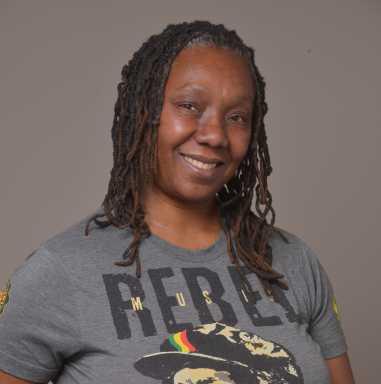
Catherine A. John-Camara, professor and department chairwoman of Africana Studies at the University of Rhode Island (URI), will have her new book, “Afroindigenization: A Theory of Grassroots Cultural Practice,” published on August 25 by Duke University Press.
According to John-Camara, the core topics of the book are culture, spirituality, and the African diaspora. It will specifically explore the power of Black Diaspora contributions, expressions, and cultural resilience, with the goal of answering this key question: “Where does the Indigenous power of enslaved Africans come from?”
She grew up in the Caribbean country of Jamaica in the 1970’s and early 1980’s. Her mother was from Clarendon, Jamaica and her father was from St. Vincent and the Grenadines in the eastern Caribbean.
Growing up in Jamaica as a young Black girl, she was aware of this fact: At that time, people of different colors, often with lighter skin and either curly or straight hair, rather than those with kinky hair, were considered more beautiful by society officially, since they were on magazines, highlighted in advertisements, and in early television shows and movies that mostly came to the country from America.
This was one of the two cultural realities present in the dual legacy of her childhood, which were reiterated by prime ministers of her generation, Michael Manley and Edward Seaga, both men whose skin color was not Black like her, as well as others prior.
The other reality: “My parents were Black people who were highly educated for their generation. They both had master’s degrees and came of age during the era of Caribbean independence. They were proud Black people. My father’s hero was Muhammad Ali. My mother wore her hair in an afro throughout the 1970’s. So, in our home there was pride in being Black and standing tall. I grew up with this model of being unashamed and happy to be a little Black girl as well,” she added.
Something that may surprise people about John-Camara: Because her father was a Caribbean Methodist minister who was relocated frequently, she has lived in four different countries, 15 different cities and attended 11 different schools in her lifetime.
“It is the highpoint of my life’s work in my profession as a professor of African American and Caribbean literature and culture with a focus on the relationship between these two broad cultural communities,” she said about publishing her book. “It was the culmination of things including decades of teaching in the classroom and hours of conversations with her friends about the state of Black people.
For John-Camara, there are several people who have had the greatest influence on her career path. A few of them include her maternal grandfather Cyril George Bailey, whose calm, spiritual resilience and example was the background conducting that shaped her life; her father Fitz John, who she said was the hero of the family, a community man, and storyteller; her mother, who was a scientist and teacher, as well as the one who hugged her and her sister and told us we had the right to breathe air on this earth no matter who said otherwise. She’s interested in writing about her maternal grandfather next.
Her interest in wanting to become an author began when she wrote plays and skits as a child for family performances, as well as some short stories that never saw the light of day. “While writing academically started out as something that was required to receive tenure and promotion, publishing articles and my first book also developed my love of writing,” she stated.
She was a professor at the University of Oklahoma for 23 years before arriving at URI in 2021. She arrived when the department had just moved from a program status that lasted approximately 20 years to departmentalization after George Floyd’s death, and at the time, she was initially the only full-time faculty in the unit.
It took time for her to build strong allies and hard work to fully develop it, but the department eventually grew to four fulltime faculty and three others who were shared with other units within four years.
“Writing while doing all of that was and is very difficult,” she explained. “I had to commit to weekly writing groups on Zoom for an hour here and there as well as occasional weekend writing retreats to get the book done. What motivates me most is teaching. I have had the luxury and freedom throughout my career of teaching courses that I designed in the ways that I envisioned. This has been my most creative and inspirational space. I have learned from my students, and I suspect they have learned from me as well. This has significantly influenced what I wrote and why I write.”
She added that even though being a department chair and professor is not easy, it comes with certain perks and luxuries, such as having more control over when and how you do your work and pass the time.
Though she doesn’t believe many will read this book from cover to cover, John-Camara hopes that audiences who read various portions of this book will gain some insight into the enormous power that we, the descendants of our enslaved ancestors, carry with us.
What she wanted to do was give people, Black people in particular, something of themselves and for themselves in a world that, despite all the glitz, glamour, and wealth, still reinforces their nothingness.
Her message to the Black community; “You are not nothing!!! You have more power than you know.”
Her goal is to inspire all individuals, including younger generations in communities in Rhode Island, Jamaica, and the Caribbean overall, to reconsider the cultural, spiritual and experiential past of their ancestors, even the painful aspects, and see things with new eyes.
“If they can shift their internal vision of themselves and the past of their people and take something from this into their lives and activism, then my task will have been accomplished,” she continued.
Those who are interested can pre-order the book at dukeupress.edu/afroindigenization.