
Trump administration sanctions target Cuba’s military, elites
The Trump administration says it is taking “decisive action” to protect US national security by imposing sanctions on Cuba’s military and elites.
US Secretary of State Marco Rubio, the son of Cuban immigrants, based in Miami, said on Thursday, May 7, that the administration’s sanctions are aimed at depriving Cuba’s government and military of “access to illicit assets.”
Pursuant to President Trump’s Executive Order 14404 of May 1, 2026, “Imposing Sanctions on Those Responsible for Repression in Cuba and for Threats to United States National Security and Foreign Policy,” Rubio said he “designated” Grupo de Administracion Empresarial S.A. (GAESA) for “operating or having operated in the financial services sector of the Cuban economy.”
The US Secretary of State also said he “designated” Ania Guillermina Lastres Morera (LASTRES) for “being or having been a leader, official, senior executive officer, or member of the board of directors of GAESA.”
In addition, Rubio said he “designated” Moa Nickel SA (MNSA) for “operating or having operated in the metals and mining sector of the Cuban economy.”
“These sanctions are part of the Trump administration’s comprehensive campaign to address the pressing national security threats posed by Cuba’s communist regime and hold accountable the regime and those who provide it material or financial support,” he said.
US Secretary of State Marco Rubio speaks during a press briefing in the James S. Brady Press Briefing Room at the White House in Washington, D.C., U.S., May 5, 2026.REUTERS/Kylie CooperRubio charged that, just 90 miles from the American homeland, the Cuban government has “brought the island to ruin and auctioned off the island as a platform for foreign intelligence, military and terror operations.”
He warned that more designations would be coming in days and weeks ahead.
Rubio charged that GAESA, a Cuban military-controlled umbrella enterprise, is “the heart of Cuba’s kleptocratic communist system.”
“Controlling an estimated 40% or more of the island’s economy, GAESA is involved in various sectors of the Cuban economy and is designed to generate income not for the Cuban people, but only for the benefit of its corrupt elites,” he alleged.
“While the Cuban people suffer from hunger, disease and chronic under-investment in critical infrastructure such as its power grid, much of the proceeds of GAESA’s activities are funneled away to hidden overseas bank accounts,” Rubio added.
He pointed to recent public estimates that claimed that GAESA’s revenues are “likely more than three times the state’s budget,” and that “GAESA likely controls up to $20 billion in illicit assets.”
Rubio also claimed that Lastres, the executive president of GAESA, is “responsible for the management of GAESA’s illicit assets held internationally.”
In addition, the US Secretary of State, claimed that MNSA, a joint venture between Sherritt International Corporation and the Cuban state-owned La Compania General de Niquel, “has exploited Cuba’s natural resources to benefit the regime at the expense of the Cuban people.”
“It profits from assets that were originally expropriated by the Cuban regime from US persons and corporations,” he said.
As a result of Thursday’s sanctions-related actions, and in accordance with Trump’s Executive Order 14404 of May 1, 2026, Rubio said “all property and interests in property of the designated persons described above that are in the United States or in possession or control of US persons are blocked and must be reported to the Department of Treasury’s Office of Foreign Assets Control (OFAC).”
Additionally, he said all entities and individuals that have ownership, either directly or indirectly, 50 percent or more by one or more blocked persons, are also blocked.
Rubio said all transactions by US persons or within (or transiting) the United States that involve any property or interests in property of designated or otherwise blocked persons are prohibited, “unless authorized by a general or specific license issued by OFAC or exempt.”
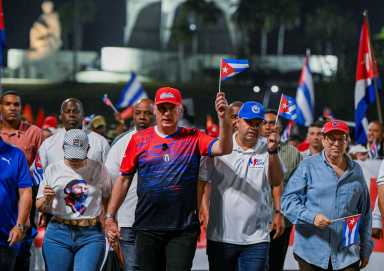
A man waves a Cuban flag after a ceremony marking the 65th anniversary of Fidel Castro’s declaration of the socialist character of the Cuban Revolution, made on the eve of the Bay of Pigs invasion in 1961, in Havana, Cuba April 16, 2026.REUTERS/Norlys PerezHe said these prohibitions include the making of any contribution or provision of funds, goods, or services by, to, or for the benefit of any blocked person and the receipt of any contribution or provision of funds, goods, or services from any such person.
Rubio warned that foreign persons who engage in transactions with persons designated pursuant to E.O. 14404 – or who operate in the energy, defense and related materiel, metals and mining, financial services, or security sector of the Cuban economy, as identified in E.O. 14404 – are “themselves at risk of sanctions.”
“Non-US persons, including foreign financial institutions, should proceed with caution in any dealings with a party sanctioned under this authority,” he said. “Actions to return assets to a sanctioned party or transfer them to another jurisdiction for potential use by the target could expose non-US persons to significant sanctions risk.
“All property and interests in property of persons that are blocked pursuant to the CACR continue to be blocked,” Rubio added. “The CACR prohibits persons subject to US jurisdiction from dealing in property in which Cuba or a Cuban national has an interest, unless authorized or exempt.”
CACR is the Cuban Assets Control Regulations, a set of US Treasury regulations enforcing a comprehensive trade embargo against Cuba.
These regulations, managed by OFAC, restrict travel, financial transactions and imports.
Rubio stressed that the US’ action is being taken pursuant to Executive Order 14404, “which authorizes sanctions on Cuban regime officials responsible for repression and threats to US national security.”
He said this action also furthers both E.O. 14380, “Addressing Threats to the United States by the Government of Cuba”, and National Security Presidential Memorandum 5 (NSPM-5), “which directs the Executive Branch to improve human rights, encourage the rule of law, foster free markets and free enterprise, and promote democracy in Cuba.”