
Guyana and Venezuela square off at World Court over border lines
The Caribbean Community’s largest and most resource-rich country and neighboring Venezuela are squaring off at the World Court in The Netherlands this week over Venezuela’s claim to a large swath of Guyana, with Guyanese officials telling the panel of judges that neither Venezuela nor colonial-era Spain had ever administered or controlled the area in dispute.
At the heart of the issue is the Venezuelan claim that an international tribunal had cheated it out of Guyana’s mineral, oil, and gas-rich Essequibo region during an 1899 arbitration process, even though it had not made such charges until nearly seven decades after that process. The Essequibo encompasses about two-thirds of Guyana’s landmass.
The court is hearing oral arguments up to May 11 from both sides and will then allow both to respond to each other before wrapping up this aspect while they deliberate and prepare for a final ruling later this year or early next year.
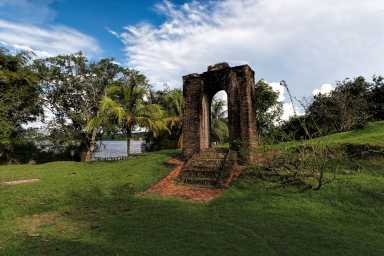
Presenting on Monday, the Guyana legal and governmental team told the court that Spain, the European colonial power in large parts of South America, incidentally had nothing to do with control of Guyana, as the Dutch were the first and main colonizers of the country.
“The Spanish, they were nowhere to be found, not east of the Orinoco, at any rate,” said Guyanese case agent and former vice president Carl Greenidge. “Their nearest outpost was San Tome on the banks of the Orinoco. This was the easternmost Spanish settlement. The Spanish governor there was candid about his predicament. The settlement, he wrote, was ‘so far distant from other Spanish positions.’
He argued that Venezuela was the one which had consistently pushed for, and had obtained, the arbitration to settle border lines, and yet today is the one suggesting that it had been cheated out of the area even though it had celebrated the demarcation process because it had given Venezuela control of the famous oil-rich Orinoco Delta.
“The history is clear, and established by the evidence before the court,” Greenridge stated. “It was Venezuela that insisted on arbitration. Venezuela heralded and celebrated the treaty as the accomplishment of its long-sought objective (Orinoco). It neither questioned, challenged, nor criticized the treaty but in these proceedings, Venezuela takes exactly the opposite position.”
Guyanese delegation attorney Pierre d’Argent suggested that Venezuela has not offered any new arguments for its case.
“It must be concluded, therefore, that Venezuela has not discovered any new fact of such a nature, had it been known as to be a decisive factor on the conclusions reached by the court in its judgments of 2020 and 2023 and in these conditions, these judgments remain res judicata for the parties in the court itself.”
To bolster claims as to who controls the vast area, Guyanese Ambassador Donnette Streete argued that Venezuela has never been in control of the area it disputes, noting that local officials collect taxes, administer the region and preside over the elections of parliamentary and other officials.
The two sides have come close to military conflict on several occasions in recent years as Venezuela has stepped up its aggression towards Guyana, especially after large amounts of offshore oil and gas were discovered back in 2015.